Communicate a Scientific Concept to a Special-Needs Learner

Blindness is severe visual impairment, not correctable by standard glasses, contact lenses, medicine or surgery[1]. Because many mainstream learning methods are visual–videos, demonstrations, books–someone with blindness may not easily utilize such media to learn.
Cells reproduce and multiply. In doing so, DNA must be copied and replicated. Because DNA is copied so frequently, often times, copies of new DNA may be different from the original, which causes traits of an organism to change. This is called a genetic mutation: a permanent alteration in the DNA sequence that makes up a gene[2]. Traditional methods to learn about genetic mutations include watching videos, reading, and completing worksheets. Because many of these methods require vision, people with blindness may not easily use such methods.
To overcome blindness and teach the concept of genetic mutations, I want to play the game “Telephone” or “Chinese Whispers.” This game does not require any vision, except to walk to the next person or form a line, which should not be too difficult for a person with blindness. The only skills required is the ability to speak and listen.
Telephone is an internationally popular children’s game, in which the players form a line and the first person in the line whispers a message to the ear of the next, and so on, until the last person is reached, who announces the message to the entire group[3]. The first person then compares the original message to the final message. Although the goal is to pass the message along without changing the original message, much like the goal of DNA replication, regardless, there will be errors accumulating in each passing of the message. In DNA replication, this is called a mutation.
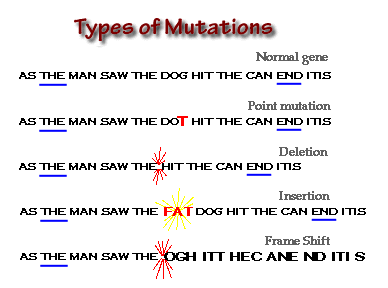
I believe this game is effective in teaching the concept of genetic mutations to a person with blindness because this game teaches the fundamentals of a genetic mutation–errors in reproducing a message–without the need for vision. We can teach the different forms of mutations by how the final message is different from the original message. For example, if the final message is longer than the original message, this is analogous to an “insertion” mutation in a genetic sequence. A visual is included below[4]. We can measure learning outcomes by the learner’s ability to recognize the different “mutations” occurring in the final message of the game.
My study of a special-needs learner has taught me that we can readily help other types of learners–not just individuals with blindness–learn through games. There are many games that can demonstrate a concept and also accommodate a disability. Most importantly, the benefit of learning through games is that games require active participation and challenge the learner. This
helps the learner retain the concept being taught.